Episode Transcript
[00:00:00] Speaker A: Foreign.
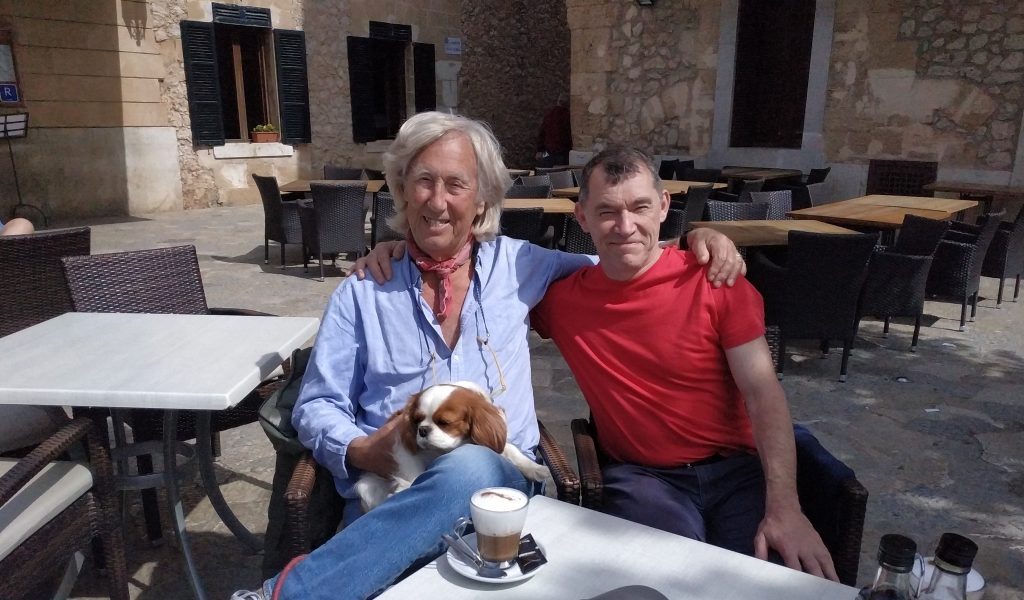
I am Serge Beddington Behrens, and with my friend Steve Taylor.
[00:00:17] Speaker B: Hello, everyone.
[00:00:20] Speaker A: We are very happy that we are starting a podcast where we're going to discuss interesting things.
But. And here's the important thing, Steve, is that we're going to link the world of spirituality and the world of practicality and politics, because we think, or at least Steve and I think, that either in podcast we see spiritual people talking about God and not relating it to the world about us, or very good political people talking about how to solve things politically, but there's no mention of spirituality, and both of us think that that needs to come into play.
Right, Steve, I'm just going to say a few words about you. Okay, then, Steve.
Steve is a dear friend, and we met at a conference where we played the blues together, and we were the entertainment for the evening.
And I, unfortunately, have broken a finger on my left hand, so I'm not so adept on the guitar, although I've never been adept, really. And.
And Steve is a really multifaceted man.
He's written about 15 books. He's a poet, he's a philosopher. He is a psychologist. His doctorate is in higher states of consciousness, and he's one of the wisest and loveliest people I know. So I feel very honored to be doing this with you, dear Steve. So why don't you come in now?
[00:02:16] Speaker B: Thank you, sir. What can I say? What a beautiful introduction.
And I feel equally benevolent and compassionate towards you.
And it's great that we have this relationship where we come up. We have a slightly different perspective on the world, but our perspective seems to harmonize, and we've done a lot of dialogues now, and every dialogue, from my perspective, has been a great experience, and we've had a lot of positive feedback from those dialogues.
So we're going to continue in that tradition.
In this podcast, we're going to have guests, aren't we? But in this initial broadcast, it's going to be just me and you in dialogue to introduce the podcast.
And it's called Fierce Grace, isn't it? Which is also the title of your upcoming book.
So maybe we should explain what we mean by fierce grace.
[00:03:09] Speaker A: Okay.
[00:03:10] Speaker B: What do you think?
[00:03:11] Speaker A: Fierce Grace is a term I use?
It actually originated from a teacher of mine called Ram Dass, who's now dead, who had a stroke at the height of his powers when he was very busy helping healing the world. Suddenly he had a stroke and was confined to a wheelchair. And he couldn't do all the things that he loved doing. Scuba diving, lecturing, at conferences.
And then he realized that this was a gift because it slowed him down. It allowed him to have time to connect to his deeper self.
And I think that the times that we're living in are fierce times.
But I feel that there's a grace because it's making us evolve, it's making us grow.
Steve, do you want to go on with that?
[00:04:12] Speaker B: I agree.
Yeah. I mean, there's a theme that's run through my research and my writings, which is that I call it transformation through turmoil. That challenge and crisis serve as a spur for personal and spiritual growth.
I was just thinking when you were speaking about Randass, I was thinking about a person I interviewed for one of my books.
She was seriously injured in a terrorist attack in London. You Remember, was it 2006? There were a series of terrorist attacks in London, and she was so severely injured that her legs had to be amputated.
And she kind of hovered on the brink of death for two or three weeks in hospital.
But when she recovered, when she regained consciousness, she felt like a completely different person. And she realized that she had to make use of the new life that she'd been given. She called it life, too.
And even the fact that she was now disabled wasn't an obstruction for her because it re.
[00:05:13] Speaker A: Enabled her.
[00:05:15] Speaker B: Exactly, exactly. And slowness was a thing that she commented on. She said that because she was. She had, you know, her legs have been amputated, she had to do everything very slowly. She could only, you know, get dressed slowly.
She could walk slowly. She had. Eventually she had some artificial limbs, but still she had to do everything very, very slowly. But she said it was a gift, you know, the gift of slowness, she called it. Because everything looks more real when you live more slowly.
Slowness brings you into harmony.
[00:05:46] Speaker A: Culture of our. Steve, where we're rushing, we have to go there. We have to do so many things. We have to struggle to succeed. We have to get. Get to the top of the ladder. If we're men and everything's rushed.
[00:06:02] Speaker B: Yeah.
And that means that we exhaust ourselves. We get disconnected from ourselves and disconnected from the world. I think that's probably one of our basic issues in the world, you know, the disease of speed, which.
[00:06:15] Speaker A: Steve, you wrote a lovely book on disconnectedness, and it was your thesis that our disconnectedness is what keeps us from being who we fully are.
Do you want to say a little bit about that?
[00:06:30] Speaker B: I've always felt that one of the basic issues with human experience for most human beings is that we experience a sense of separation a lot of people feel as though the egos who live inside their own mental space, and therefore there's a sense of duality between them and the world, between them and other human beings, and also between them and themselves.
When you feel that you're an ego living inside your mental space, you also become disconnected from your body because, you know, the body is, you know, you experience separateness towards your body.
And that sense of separateness, it causes all kinds of pathological behavior, both for us as individuals and in social terms too. I even think that, you know, social pathologies like warfare, patriarchy, and they are, they are the result of this sense of separation.
[00:07:25] Speaker A: Extreme disconnectedness. I think you call it hyper disconnected, hyper disconnection.
[00:07:30] Speaker B: It obviously varies from person to person. Some people are extremely disconnected. Hyper disconnected, as you say. Like, you know, many of our. Unfortunately, this is where we start talking about politics, but many of our political leaders are extremely disconnected people. Hyper disconnected people.
That seems to be an advantage in politics.
[00:07:53] Speaker A: I mean, do you think that, that because we're disconnected, that we choose world leaders who reflect our own pathologies? So sort of Russia is led by a Putin, Trump. America is led by a Trump.
Israel is led by a Netanyahu.
To feel that, that, that, that we create our own leaders because of our own lack of being connected to who we are?
[00:08:28] Speaker B: There's an element of that. I mean, I think these, these are, you know, they are, they're psychological. These are psychologically disordered people.
They are the, the very, the complete inverse of the leaders we should really have.
It would be great if we were led by wise, sensible, responsible, empathic people, but that's very rarely the case. But somehow, I think in our state of disconnection, these people seem appealing to us. They seem, they project confidence, decisiveness, and we misinterpret their psychopathy. We misinterpret it as a kind of confidence and charisma.
So these people, they seem to be sort of authoritarian father figures in whom we can place our trust.
You know, we can hand our responsibility over to them.
[00:09:16] Speaker A: Yeah, I mean, another way I have a looking at it is that somehow modern man, as Carl Jung said, has lost its soul.
So we lack soul. And without soul, our egos, as you said, Steve, run, you know, rule the roost. And so when our egos rule the roost, therefore, instead of being attracted to, to wise, benevolent people, when we're drawn to people who are the opposite, I mean, Trump is not big of soul. He's big of girth. He's big of materiality.
And somehow where we're drawn to where our wounded egos take us.
[00:10:06] Speaker B: Yes.
Why do you think we lost contact with our souls? Can you think of any?
[00:10:12] Speaker A: I think it goes way back to the beginnings of patriarchy, and I think that somehow we've become left brained.
As Ian Gilchrist, his great theory is that we live in the left side of our brain. That's the rational.
And we repress the right side of our brain or we repress our heart.
I think, Steve, deep down, it's that humanity lacks heart, this mysterious thing called heart, where our qualities of love and joy and beauty and courage lie. And because we don't have heart, we're drawn to the wrong things.
[00:11:07] Speaker B: I think so, yeah. I think disconnection from the heart is part of our general state of disconnection. Disconnection. Once you become an isolated ego, you lose qualities of empathy and compassion. You become kind of locked in, so you can't empathize with other people.
And your sense of separation creates a sense of lack. You feel that something's missing, so you're trying to compensate. So, you know, so you haven't, you have. You have an insatiable desire for power, for wealth, and also a sort of constant dissatisfaction that something's not quite right. You know, you need something, you know something's not. You don't feel comfortable just living in the moment.
There's a restlessness, a craving for something.
[00:11:51] Speaker A: Yes.
[00:11:52] Speaker B: So I think that that's part of our. Our pathology.
[00:11:55] Speaker A: And, and the pathology takes the shape of. We feel empty inside ourselves. Not empty in a Buddhist way, I. E. Being free of. Of chatter, but empty in being filled with nothingness.
And so we try to fill our nothingness with. With stuff and activity. And if I can have a big car and I don't feel good about myself, I can impress you in my red Ferrari and my big house somebody. Then I'm somebody. I've made it. Hooray.
[00:12:31] Speaker B: Yeah. And it doesn't work. So the more you do it, the more your dissatisfaction grows. It becomes an endless cycle. You know, you can buy bigger and more and more expensive things, but they never satisfy you. And you, eventually there's a kind of self destruction. You reach the point of, you know, complete emptiness and complete frustration.
Maybe that's when people turn to drugs or commit suicide.
[00:12:55] Speaker A: Steve, what is worrying about what's happening in the world is that it's beginning to be run more and more by billionaires who, who politically are beginning to assume more and more power in. Not only in America, where Trump is surrounded by Billionaires, but also in European countries. And when people sort of come to their governments and they complain about austerity and a lack of health care, the governments don't listen, but they listen to the billionaires because the billionaires have the power.
And so we're sort of approaching a time where our world could be led by empty hearted billionaires who are in power.
[00:13:52] Speaker B: Yeah, I mean, one of the interesting things is that the more disconnected a person is, the more they crave for wealth and power.
And because people who are disconnected, they lack, they lack empathy. They are also very manipulative.
So they have no qualms about exploiting other people, using other people. They have no qualms about pushing other people out of the way as they climb the hierarchy towards wealth and success.
So you do end up with a situation where the people in the highest positions in any society tend to be the most disconnected people.
And they use their disconnection in malevolent ways, you know, in the ways you've just described. You know, they, they fund political parties. Malevolent political parties, Malevolent political figures. Which is what's happening now in the uk, you know, with the rise of the Reform Party, which is funded by, you know, crypto billionaires who have malicious.
[00:14:54] Speaker A: Think is responsible for the rise of the Reform Party.
[00:14:59] Speaker B: Well, crypto billionaires, malevolent people, people with psychological disorders, people with narcissistic and psychopathic traits who become politicians and who fund politicians. Also the media. I think the media is very responsible. The right wing media in the uk, which is part of this whole, you know, hegemony of disconnected people.
Most of the right wing media is owned by the kind of people we're talking about, malevolent billionaires.
[00:15:31] Speaker A: But I think that, but I think we can't go too far and say every billionaire is, is, is, is malevolent because there are some very good people who of course people like to, to invent conspiracy theories about them, but as far as I know, Warren.
So what's his name?
Oh gosh, my.
I've forgotten the names of two.
Oh yes, Soros.
Oh yes, George Soros and sort of Warren Buffett.
[00:16:17] Speaker B: Oh, yeah, yeah.
[00:16:18] Speaker A: Both of whom seem to live in, in small houses and to give away huge amounts of money to very good causes.
[00:16:28] Speaker B: Yeah, I agree. I mean, obviously in politics too there are some positive, benevolent people. There are some people who feel an impulse to enact positive causes and to support positive action in the world. So by no means every politician or every wealthy person is malevolent. That's not true. At all. But I think there tends to be a higher proportion of them than in other, you know, echelons of society.
[00:16:54] Speaker A: I have a theory that if you spend a lot of time thinking about how to make more and more money and, you know, how the system works and you involve yourself in that particular world, because I think we all live in different worlds and the billionaire has a particular world.
It focuses you away from your humanity.
And so what is core about you, your humanity, where your altruism and goodness lies? It doesn't get fed the sort of watering can sort of, you know, sort of has no water left, you know, to feed the deeper parts of yourself because all the energy is going into, you know, schemes to make more money, schemes to have more power.
[00:17:46] Speaker B: Yeah. And do you. You have some personal experience of this, Serge? I mean, you were born into a very wealthy family?
[00:17:53] Speaker A: Well, yes, and I have to say that I suffered from it because that there was always an emphasis on materiality and not kind of what I felt were the real values of life.
And so my father was very disappointed that I didn't want to follow in his footsteps. And I felt a great need to divest myself of this money because I wanted to be an ordinary person. I didn't want to live in a world where sort of people would, you know, tug their forelocks at me just because I was wealthy. I wanted to become an ordinary human being. So I found means to de. Wealthify myself over the years and, you know, I hope a little bit has gone to some, you know, one or two important causes, but.
[00:18:59] Speaker B: So basically you inherited a lot of money, but you gave your money away. Is that what happened? Basically?
[00:19:06] Speaker A: I did.
I did, yes.
And so sort of what are we talking about?
We're sort of talking about, Steve, what kind of world do we want? Because money is important in the world.
You know, money is an.
Is a divine energy.
Money is not evil.
Money is just. Is neutral sort of. Money is what we do with it.
[00:19:44] Speaker B: Yeah, like.
[00:19:46] Speaker A: Like a very clever mind can be used to become a master criminal, like Sherlock Holmes's Professor Moriarty, who was this genius criminal.
Or it can be used to do beautiful things in the world.
[00:20:03] Speaker B: Yeah, yeah.
In psychology, research shows that money can make you happier if you do the right things with it, if you spend the money on yourself or keep your money or buy material possessions. And money doesn't make you happier. So a billionaire is no happier than an ordinary person, according to research.
And in fact, a billionaire suffers from a lot of stuff, psychological conditions and issues which ordinary people don't have to deal with like, mistrust and, you know, lack of enjoying the basic simple pleasures in life.
You know, there are high levels of addiction and psychopathology and depression and other psychological conditions in very rich people.
But if you use your money for altruistic causes or if you use it to by experiences rather than material goods, then it can lead to increased well being.
So, yeah, I guess it's like time, you know, you can use your time in, in positive or negative ways. You have a choice about how to, how to use it.
[00:21:07] Speaker A: So. So our challenge is how can we use our time, Steve, to create, to do things, to, to make a difference in the world.
[00:21:20] Speaker B: Yeah, and I guess that's what we're going to talk about in this podcast, isn't it? We're going to talk about how to utilize Fierce Grace to make the world a better place.
To help to, to reconnect people to their true essence and to, to help reconnect, you know, the human race to, to nature and to, you know, transcendent source, to the transcendent energy which flows around us all the time, but which we are often disconnected from.
[00:21:52] Speaker A: I mean, I sometimes feel that having learned of having been very disconnected myself because I, you know, because I grew up with models, you know, where sort of money was important, not being connected to other human beings was important. I grew up very disconnected, so I had to reconnect myself. And I think that's why I became a psychotherapist. That is sort of one of the hats I wear. And I see that most of the people I work with have, have a disconnection about them, you know, that they, that they don't know who they really are, but they don't even know sort of how they feel that their unconscious remains in their unconscious. They don't know that they're angry, they don't know that they're sad. They don't know that they have strong feelings about something. And they also don't know that they're much more loving and joyful than they think they are.
So sort of maybe our journey is that we have to come into the world disconnected in order to learn how to reconnect.
[00:23:13] Speaker B: Well, but children are naturally connected, aren't they? Children live in a natural state of oneness with the world and oneness with themselves. It's really only when we get older, once we become adolescents, that we start to disconnect.
[00:23:27] Speaker A: Steve, I didn't live in a state of oneness. You didn't when I was a child, did you?
[00:23:33] Speaker B: I Think so, yeah. Yeah.
[00:23:35] Speaker A: Well, gosh, you're lucky.
[00:23:37] Speaker B: Well, I think in my case was
[00:23:39] Speaker A: your background, sort of. What was your background?
[00:23:42] Speaker B: Well, my background was very, very ordinary, I guess. My parents didn't have much money.
My dad worked quite hard, but his jobs were not particularly well paid, so we didn't have much money. And basically all I remember from my childhood is playing football on the street with the other kids on the road. We lived in a fairly small house on a narrow road with lots of other kids, so it was great. You know, we played all the time.
There was a park nearby, so we would go to the. To the park to play football.
So basically all I remember is playing with other kids.
I remember the park and the street.
So it was.
It didn't feel spectacular at the time, but in retrospect it was, you know, it was quite a joyful, harmonious childhood.
My parents were quite loving, quite attentive.
So even though we didn't have much money, you know, it was kind of emotionally rich, my childhood, for which I'm very grateful. I think it was a good basis for the rest of my life, for my development.
[00:24:49] Speaker A: But I think, I mean, you know, it's interesting, our polarity, but I think we mustn't say that, you know, that if you're poor you're going to be naturally happier and more connected and if you're rich, you're. You're always going to be disconnected. I think that, you know, every situation is different.
[00:25:10] Speaker B: I think so. And I think it depends a lot on your parents too. Obviously. Obviously the key factor in anyone's upbringing is the attitude of their parents and the relationship of the parents.
So. So obviously that varies. You know, you. Somebody from a poor working class background can have loving parents, in which case they will develop in a positive way. Somebody from a wealthy background may have dysfunctional parents who do not give them love and attention.
So it obviously varies.
[00:25:39] Speaker A: So what, were your parents loving?
[00:25:42] Speaker B: Yeah, they were nice. My mum was loving. Yeah, they were very young when they had children, so I think it was. They weren't maybe weren't really ready for the experience of being parents. But yeah, my father loved playing with us. He was a very sporty guy, so he loved to play football and cricket with us.
So, yeah, they were nice people. They weren't what you would call educated intellectual people.
You know, they never read any of my books. They couldn't make any sense of my books. They just couldn't come to terms with them. But they were, you know, they were, they were nice people. So I'm grateful for that. You know, it was a harmonious childhood.
So how does. How does spirituality fit into this? Serge, we've talked about the general state of disconnection.
[00:26:34] Speaker A: Okay, here's how I think it comes out.
I.
I mean, I have just finished writing a book called, if I can remember the title.
[00:26:49] Speaker B: The same as this podcast.
[00:26:51] Speaker A: No, no, no. Oh, no, no. I changed the name. It's called Regenerating the Planet. Exploring the Sacred Path of the Warrior. Activist and emphasis is that as activists, I think two things. I think that all of us, we need to be activists for something to make a better world.
But where the. But where the spirituality comes in is not that we need to be religious and go to church and be a Buddhist or a Christian or anything else, but that we embody good, good human values. I think it's about our humanity.
I often prefer to use the word humanity than spirituality.
Spirituality conjures up things. You've got to sit in a lotus position and, you know, and sort of light candles and say, oh, I am
[00:27:55] Speaker B: sitting in a lotus position. I have a candle.
I'm not sitting in a lotus position.
[00:28:00] Speaker A: Actually, you're not half lotus. Yeah.
Well, I think that we need to be decent people, and somehow I think a lot of us need to work at it, because the models we have for being a human being are not models that include joy and altruism and.
And being of service.
And I think that we need to be able to have lives more that are about giving than about just getting for ourselves.
And that's what I mean by spirituality. It's not some religious thing. You know, meditate and pray every day.
[00:28:54] Speaker B: Yeah, I don't think human beings. Yeah, I don't. I don't think spirituality necessarily has anything to do with religion. There are so many religious people who are not spiritual at all. You know, the fundamentalist religious people. Of course, there are some religious people who are very spiritual.
[00:29:12] Speaker A: Yeah, absolutely.
[00:29:14] Speaker B: Yeah. But at the same time, there are people who are spiritual and completely non religious. And I would call myself, I refer to myself as completely non religious.
[00:29:23] Speaker A: And exactly the same with me, Steve. I've studied sort of many different paths. I've, you know, I've worked with shamans. I've worked with, you know, Tibetan sort of Buddhist monks. I've sat with Indian gurus. I've, you know, I've studied the mystical tradition of.
Of Christianity. I'd done Buddhist meditation.
But, but, but, but I'm not religious.
[00:29:55] Speaker B: No, no.
Reminds me of a great song by Van Morrison called no Guru, no method, no teacher.
He just, he just sings a. No guru, no method, no teacher. Just you and I are nature.
[00:30:10] Speaker A: Great.
[00:30:12] Speaker B: Yeah.
But, yeah, I, I, I agree.
I mean, I, I respect a lot of spiritual traditions, a lot of religions, but I'm not affiliated to any tradition.
I've never felt the need to align myself with any particular spiritual or religious tradition.
[00:30:31] Speaker A: Yeah, yeah, same here.
[00:30:34] Speaker B: And I know lots of people who know nothing about spirituality, who know nothing about spiritual traditions, who have never meditated, who've never done yoga or, you know, been inside a temple or even a church. But they are spiritual people. They are just naturally good people.
Yeah, they are people who are extremely altruistic people, who are selfless, extremely kind.
So I think spirituality is something that transcends all religion, even transcends spiritual traditions.
[00:31:12] Speaker A: You find these people a lot in, in, in tribal cultures.
Yeah, because they're the story, you know, that the stories they've had have been ones of being connected to the earth, of being connected to your fellow human beings. So they haven't grown up disconnected. I think that being connected is about being spiritual.
[00:31:40] Speaker B: Yeah, exactly. I mean, that's how I would define spirituality, as being connected. Yeah. Transcending separation and entering into connection with nature, with other human beings, other living beings, and with your own body and your own soul.
And it's a continuum that I talk about, the continuum of connection.
So you could be at a certain point of connection, you could have reached a certain point in the continuum. But there's, there are always deeper levels of connection.
You can always move deeper and deeper into connection with nature, into connection with other beings, and also with your own inner space and your own essence.
[00:32:21] Speaker A: And that's where we need to put work in. I mean, in all the books I write, I always have exercises after each chapter saying, okay, you've learned, you've read a chapter on forgiveness or a chapter on courage. Okay, you've learned it with your minds, but now you have to practice it.
And the thing I have got from certain religions is that spiritual masters give you processes to do.
Is that the spiritual practices and we need to do these practices, but really that we should just call them.
Sort of habits.
I mean, for example, Steve, I have a habit when I take the dog out in the morning. I think we discussed this. I always choose to do it in a spirit of bonhomie. I live in a little town and I smile at everyone I pass and, you know, and I have a great looking little spaniel dog and people smile when they see him. So that encourages a Friendly thing. And then if I bump into someone I know, I'll, you know, chat.
And then I come back from my walk and I feel really good. It's as if that exchange has fed me. And I realize I need that food. I. Of this practice of being friendly, I need this food as much as I need my sort of Muslim fruit, which I then have for breakfast after my dog walk.
[00:34:13] Speaker B: Because it brings you into connection, doesn't it?
[00:34:15] Speaker A: It brings us into connection.
It's all about connection, isn't it?
[00:34:21] Speaker B: That's right. I mean, I. I'm.
I'm quite solitary, as I guess every writer is quite solitary.
So I spend a lot of time on my own.
But like you, I love to interact with other people, especially people I don't know particularly well. You know, I love to go into shops and speak to people and smile at people.
In fact, in my book the Adventure, I highlighted three basic practices that you can use every day to increase your connection to other people.
And the first one was respectful attention.
So give everybody you meet respectful attention, even if it's the bus driver or the checkout person at the shop, the person, the people you pass on the street. Give everybody your respectful attention.
[00:35:07] Speaker A: Respectful attention, yeah.
[00:35:09] Speaker B: And the second one is radical. The second one is radical friendliness.
So that means talking to people. If you're standing in a queue talking to people on the bus or at the bus stop, you know, talking to the taxi driver, talking to the people sitting opposite you or next to you on the train.
So it means creating a connection with every person. Well, as many people as possible.
And the third one is conscious altruism.
So every day I say that you should be on altruism alert. So if anybody needs your help, if anybody looks like they may need some support or help, you're there to provide it for them. And obviously the people in your family, in your community, you can practice altruism towards them as well.
[00:35:59] Speaker A: And it's all about connection to be connected, isn't it?
[00:36:01] Speaker B: It's all about connection, yeah. I mean, altruism is basically connection.
It's connection, you know, not just between you and the person who receives your altruism. It's a connection between the whole human race. It's something transcendent, you know, you're connecting to some collective being that lies behind our individuality. That's why it feels so great to be altruistic, because you're connecting to something bigger.
[00:36:27] Speaker A: What I think stands in the way of that, and I think it's connected to the disconnection, is that in our Western culture, we're brought up to be very critical of people.
And I know that I learned to be critical of people from my mother and my father.
[00:36:51] Speaker B: Yeah.
[00:36:51] Speaker A: You know, sort of people who were not dressed right or didn't look right or if something was not in their sort of mindset, you know, that they say, oh, that awful person. And I learned that.
And I learned to be critical not only of other people, but of myself and always see the things that were wrong with me. Well, that further disconnected me not only from other people, you know, because I'm not going to connect with someone, you know, if I see him or her in a critical light. But I also disconnected me from me because I didn't want to feel so critical about me. It was painful to have this. This. This critical thing, so that we have to see that disconnection pattern that. That. That. That pattern of being critical and somehow knock it on the head.
And I agree. And I think that the way we knock it on the head is doing those three practices that you speak about, Steve.
[00:38:00] Speaker B: Yeah.
And I think that is part of spiritual development, transcending those judgmental, critical traits.
[00:38:09] Speaker A: I'll tell you a story.
Three nights ago, I went out for dinner with a woman and her husband, and.
And my wife was there. And I'd always felt critical of the husband. I noticed this, and I chose before I went out for dinner that I was really going to embrace him and knock that part of me on the head.
As a result, I enjoyed the dinner much more. I felt warm. I enjoyed him. I gave him a space to be himself so that he could talk freely instead of being subjected to surgeries. Oh, you're not good enough. There's something wrong with you. Creepy vibes.
And so I had a much nicer evening.
I mean, what we're down to is what Albert Schweitzer and Gandhi talked about. The need to respect.
It's about respecting all people. You know, we may not like what everyone does. We may not like Elon Musk, but we have to respect him as a human being who's part of the same human race.
We may not approve of what he does, but we have to respect.
Because I think it was. It was Meister Eckhart who said, everyone is an aristocrat of soul.
We're all souls.
[00:39:50] Speaker B: Yeah.
[00:39:52] Speaker A: Not assholes from.
Not assholes, but real souls.
[00:39:58] Speaker B: Yeah.
Yeah. And I would add that it's about empathy. It's about seeing the world and experiencing the world through other people's souls.
I had a. I had an Experience.
A few years ago, maybe five years ago, when I was going to a city, I think it was Leeds, to do a talk.
And I stopped off at a pub to have a meal. And I felt kind of buoyant and quite optimistic and quite in a kind of spiritual mood.
And I was in this busy pub. And some of the people were superficially quite objectionable people. They were like young lads who were talking about beer and swearing all the time, talking about football, being really aggressive. And then there were some businessmen who were talking on the phones and being quite pompous, trying to impress each other.
And there were some old guys who were complaining about things. I was kind of listening in on conversations.
But I felt such a surge of affection for everybody. So even these people who were superficially objectionable, I knew that there was something. Something kind of divine inside them. I knew that they were all just trying to seek happiness in some way. You know, we're all dealing with the same challenges.
We were all undergoing the same process.
We were all sharing the same journey together. So I felt this incredible glow of compassion for all of these people. And it didn't matter that they were superficially a bit, you know, negative. You know, I kind of. I love them all. There was something inside them that I could. I could love.
[00:41:27] Speaker A: Well, Steve, it's extraordinary you say that, that about six months ago, I was at Palma Airport sort of waiting to fly back to London.
And I was just sitting in the waiting lounge, you know, and I'd had a coffee. I'd gone to Starbucks and had one of those expensive, you know, Starbucks coffee. I mean, I'm not religious enough to sort of boycott, you know, Starbucks.
I mean, I know it's in the armament business, but Is it. But anyway, I had my Starbucks, and I was just sitting there.
And suddenly I felt everyone around me is my family. We're all different. We're all going in different directions. But I'm at home here.
And it was an extraordinary feeling. It wasn't some mystical oosh, but. But it was a very gentle sense said, you know, everyone here is my brother and sister. I'm connected to all these people. And.
And I felt warm. I didn't feel alone. I felt I'm surrounded with friends. And somehow I saw that other people picked this up because, you know, people began to smile at me, you know, And I remember that there was a very pretty girl just sitting opposite me. She caught my eye and gave me a really big smile. And that really bucked me up. Wow. You know, this. This really pretty girl Smiling at this old fogy. But, but, but it was a real warm feeling. And I suddenly thought if more of us felt like that more of the time, we wouldn't have wars, we wouldn't have all these separations. You know, I belong to this tribe. You know, I'm right wing and you're left wing. You know, I'm rich and you're poor, you know, I'm successful, you're unsuccessful. We wouldn't have all these stories about that somehow we'd all be in the same game, which essentially I felt then we all are in the same game. We're all, you know, we're all struggling human beings sort of struggling to find ourselves, you know, struggling to do it.
And then I tell you, just the last thing, Steve, I thought sort of maybe the new secret weapon that has to be done, given that. Teilhard de Chardas once said there's more power inside an open heart than inside an atomic bomb. He said that in 1945.
Maybe that we can use a heart field as a secret weapon to kind of infiltrate and turn people on without their knowing. Sort of maybe that this is the spiritual power. Sort of maybe that this could be used politically.
I don't know in what way, but it's just an idea that I've been dancing with. Little bit. The power of the heart field, the power of the planetary heart field, the
[00:44:52] Speaker B: power of the universal heart and the
[00:44:55] Speaker A: power of the universal. Yeah, I know.
[00:44:57] Speaker B: I think it. It goes back to connection. There is a deep level of our being where we're all interconnected. We all share the same deep being.
We can feel that when we are compassionate, when we are altruistic, or we connect to that deeper level, and also not just in human beings, to the whole of the natural world, to the whole cosmos.
In these moments, we connect not just with other people, but with nature, with some transcendent dimension of the cosmos.
But normally we're alienated from that deep level. We live in a superficial separateness, a superficial disconnection. And that's where we, you know, we start to jostle and start to struggle and start to fight with each other at that level of superficial separateness. That's the level of where we feel dissatisfied. We feel the need to gain other people's territory, to gain other people's wealth, to push other people out the way, even to kill each other, to kill other people because we're alienated from our superficial. Sorry. From our deep oneness.
[00:46:01] Speaker A: In your book on disconnection, I remember you saying that wars didn't happen when people in the hunter gatherer stage, because we did, you know, because, because sort of people were sort of traveling all the time, so we didn't covered other people's possessions because we were always on the move.
[00:46:25] Speaker B: Well, that's, that's an established archaeological fact that warfare is a late development in human history.
Warfare only became common about five and a half thousand. Sorry, about 6,000 years ago, 4,000 BC and it became common in the Middle east initially and started to spread slowly through Central Asia and into Europe.
But until then, there is no evidence of collective warfare and also patriarchy. There's no evidence of patriarchy until around 6000 B.C. sorry, 4000 B.C. something happened in the human psyche around that time to put us into a state of disconnection.
And the warfare that erupted, the patriarchy that became common, it was all part of this shift into ego separation.
[00:47:18] Speaker A: So what was that something?
[00:47:21] Speaker B: Well, nobody really knows. In my book the Fall, I suggest that there were environmental factors because before 4000 BC the whole of Africa, the whole of Central Asia and the Middle east was a fertile area, but it became dry quite quickly. Around that time. There was a process of desiccation and desertification. And all the groups who lived in these areas where there was a process of desertification, they developed ego separation.
They became warlike and patriarchal and also theistic. Theistic religion did not exist until that time either.
So maybe there was an environmental connection.
Some people might say it was part of the evolution of consciousness that human beings had to fall into separation so that we can emerge into a deeper level of connection later in our development.
[00:48:15] Speaker A: I. E.
Thought sort of back to the idea of fierce grace, that we've got to go. Go into the fierceness in order to find ourselves.
[00:48:27] Speaker B: Well, I think in response to challenge, we. We do find ourselves.
You know, we uncover deeper levels of our being in response to challenge and crisis.
[00:48:37] Speaker A: I think. Let's talk about that next time, Steve. Yeah, I think we'll, you know, I think we'll. We'll sort of come to an end on this note of, of the challenge of.
Of conflict and sort of fierceness and where we're exactly challenged, because I think we're challenged at many levels. We're challenged politically, economically, ecologically, spiritually, psychologically, financially, and.
And we need these challenges.
We need these challenges in order to evolve. So let's sort of continue on that front.
[00:49:23] Speaker B: Yeah, that will be the theme of the following weeks and months in our podcast. Yes, the fierce grace that we use to evolve in the face of crisis and challenge.
[00:49:33] Speaker A: Yeah. Well, thank you. Okay.
[00:49:35] Speaker B: Thank you, sir.
[00:49:37] Speaker A: Thank you, Steve. Yeah. And thank you all who are listening to us. Thank you.
[00:49:41] Speaker B: Thanks, everybody.
[00:49:43] Speaker A: Bye.